Kitchen Guides
Internal Meat Temperatures: USDA Safe Minimums and How to Check
The USDA safe minimum internal temperatures for poultry, meat, fish and egg dishes, where to put the thermometer, and how to check it is accurate.
By The Thriving Table · Edited by Julian Oribe · Published November 25, 2026 · 5 min read
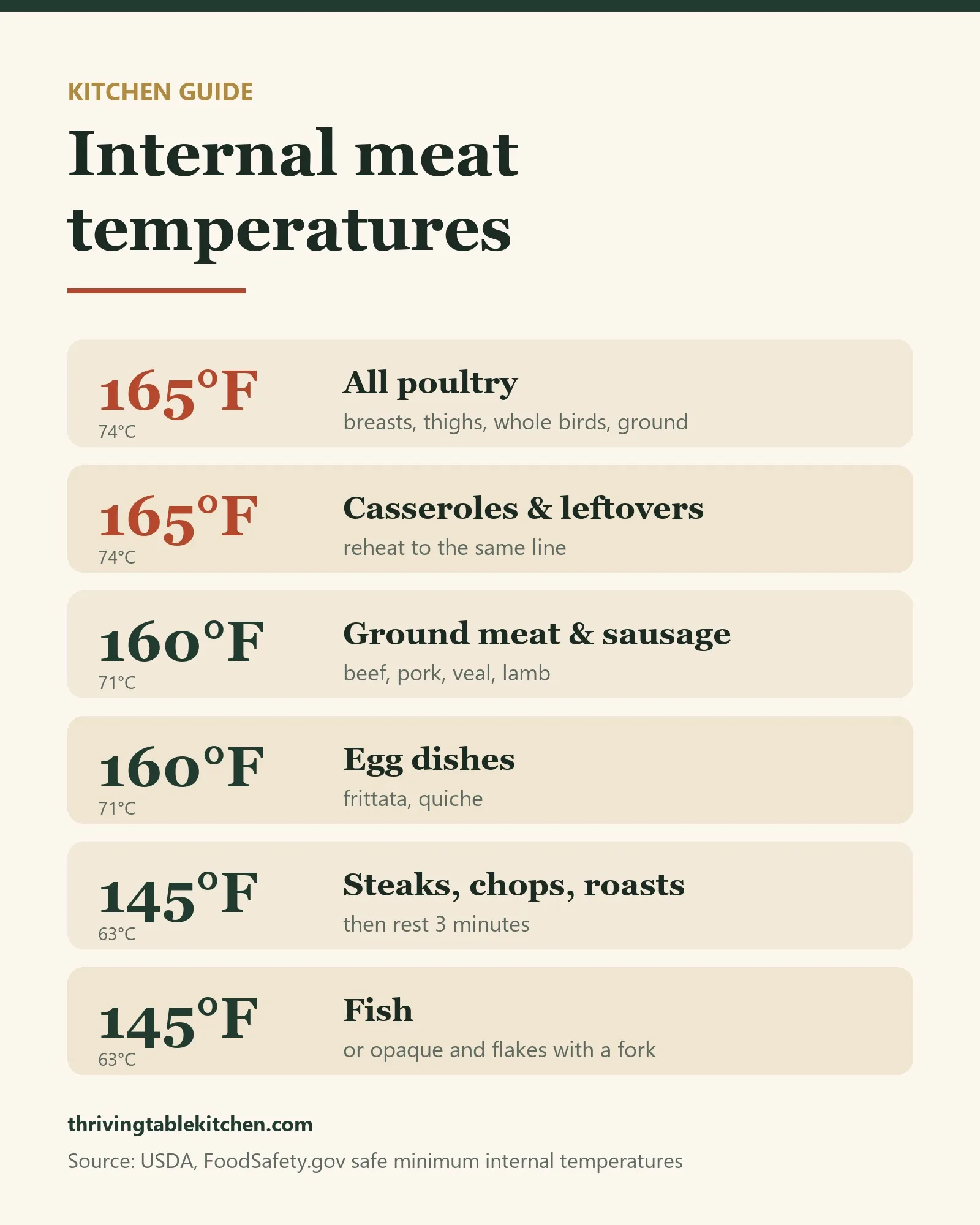
Color, juices and cooking time are guesses. A thermometer is a measurement. The U.S. Department of Agriculture's advice is to always use a food thermometer to check whether meat, poultry or fish has reached a safe minimum internal temperature. This guide gives the official numbers, explains the one rule that trips people up (the rest time), and covers where to put the probe so the reading means something.
All the temperatures below come from the USDA chart on FoodSafety.gov, last reviewed by the agency on November 21, 2024. They are the same numbers the Food Safety and Inspection Service uses. This page is part of our kitchen guides.
The USDA chart, in one table
| Food | Safe minimum internal temperature | Rest time |
|---|---|---|
| Chicken, turkey and all poultry (whole, breasts, legs, thighs, wings, ground) | 165°F (74°C) | None |
| Beef, veal, lamb, bison and goat: steaks, roasts, chops | 145°F (63°C) | 3 minutes |
| Pork: steaks, roasts, chops | 145°F (63°C) | 3 minutes |
| Raw ham | 145°F (63°C) | 3 minutes |
| Ground beef, pork, veal and lamb, and sausage | 160°F (71°C) | None |
| Fish (whole or fillet) | 145°F (63°C), or until the flesh is no longer translucent and flakes with a fork | None |
| Egg dishes such as frittata or quiche | 160°F (71°C) | None |
| Casseroles and leftovers | 165°F (74°C) | None |
| Precooked ham, to reheat | 165°F (74°C); 140°F (60°C) for hams packaged in USDA-inspected plants | None |
Two lines are worth reading twice. Poultry has one number, 165°F, whether it is a breast, a thigh or ground turkey. And whole cuts of beef, pork, lamb and veal are safe at 145°F only with the rest time included.
What the rest time does
The USDA lists a 3-minute rest for steaks, chops and roasts because the cooking does not stop the moment the meat leaves the heat. The outside of the meat is hotter than the center, and for a few minutes that heat keeps moving inward. In the agency's words, the rest lets the innermost parts and juices of the meat become fully and safely cooked.
In practice this changes the order of things. Take the meat off the heat, let it sit on a plate or board for 3 minutes, then cut. If you cut a pork chop the instant it reads 145°F, you have skipped part of the safety step. The rest is not optional on the chart, and it is not just about juicier slices.
What the rest does not do is fix a low reading. If the thermometer shows 135°F when the meat comes off the heat, 3 minutes on the board will not reliably carry it to 145°F. Put it back.
Safe is not always the best texture
The chart gives the minimum for safety, not the best temperature for eating. For lean cuts, going far past the minimum is what makes them dry: a pork chop at 145°F with its rest is safe and still moist; the same chop at 165°F is safe and much drier.
Cuts with a lot of connective tissue work the other way. Chicken thighs are safe at 165°F, like breasts, but many cooks take them higher because the collagen in dark meat keeps softening as the temperature climbs. Pot roast and pork shoulder are safe at 145°F after the rest, and they only become tender enough to shred after long, slow cooking well past that point. Going above the safe minimum is a choice about texture. Going below it is not a choice.
Where to put the thermometer
The USDA guide to food thermometers gives three placement rules that solve most bad readings:
- Thickest part, away from bone, fat or gristle. Bone and fat heat differently from the meat around them, so a probe touching them reads the wrong thing.
- Thin foods from the side. For a chicken breast, a pork chop or a burger, slide the probe in horizontally through the side until the tip sits in the center. Going straight down often puts the tip through the meat and onto the pan.
- Check each piece. Pieces in the same pan cook at different speeds. The biggest piece is the one to check last.
For a whole bird, check the thickest part of the breast and the innermost part of the thigh, without touching bone. Every spot you check needs to read 165°F.
Probe depth matters too. Digital instant-read thermometers sense the temperature at the tip, so the tip is what needs to be in the center. Dial (bimetal) thermometers average the temperature along the first 2 to 3 inches of the stem, which is why the USDA notes they cannot measure thin foods unless they go in sideways.
How to check that your thermometer is accurate
The USDA says most food thermometers read within 2 to 4°F of the true temperature, and it describes two ways to check yours: ice water, which it recommends for most thermometers, and boiling water, for higher temperatures. The ice-water check takes two minutes:
- Fill a tall glass to the top with ice, then add cold water. Stir and wait about a minute.
- Put the probe in the center of the glass, without touching the sides or the bottom.
- Water with ice in it sits at 32°F (0°C). If your thermometer reads more than a couple of degrees off, recalibrate it as the manufacturer describes, or replace it.
A thermometer that reads 4°F low will tell you a chicken breast is at 165°F when it is really at 161°F. That is the reason to check it now and then, and not only when a reading looks odd.
Which kind of thermometer to use
For everyday cooking, a digital instant-read thermometer is the simplest: it gives a reading in seconds and works in thin and thick foods. It is meant to check the food and come out, not to stay in the oven. If you want to watch a roast without opening the oven door, the USDA lists oven-cord thermometers: the probe stays in the meat and a cable runs to a display outside.
Whatever you use, wash the probe with hot, soapy water after it touches raw meat, before you use it to check anything else.
Quick reference
- Poultry, casseroles and leftovers: 165°F (74°C).
- Ground meat and egg dishes: 160°F (71°C).
- Steaks, chops, roasts and raw ham: 145°F (63°C), then rest 3 minutes.
- Fish: 145°F (63°C), or opaque flesh that flakes with a fork.
To switch between Fahrenheit and Celsius at the stove, use the oven temperature converter. For the other half of getting a recipe right, measuring, read our guide on how to measure flour.
Questions, answered.
Is pork safe if it is still a little pink at 145°F?
The USDA safe minimum for pork steaks, chops and roasts is 145°F (63°C) followed by a 3-minute rest. The USDA notes that color is not a reliable sign of doneness, so the thermometer reading is what counts. Ground pork needs 160°F (71°C).
Why does ground meat need a higher temperature than a steak?
Grinding mixes the surface of the meat, where bacteria live, into the whole batch. A steak's surface gets direct heat; the inside of a burger does not. That is why the USDA sets 160°F for ground beef, pork, veal and lamb and 145°F for whole cuts.
Do chicken thighs need a different temperature than chicken breasts?
Not for safety. The USDA safe minimum is 165°F (74°C) for all poultry, breasts and thighs alike. Many cooks take thighs higher for texture, because the extra connective tissue softens with more heat, but 165°F is the safety line.
Can I leave an instant-read thermometer in the oven?
No. Instant-read thermometers are made to check food and come out. For a probe that stays in the food while it cooks, use one sold as oven-safe or an oven-cord thermometer, as the USDA guide to food thermometers explains.